Statement


I have always privileged written above visual language for its precision.  As a painter I have envied words their success in communication, their clarity, their universality, their common resonance.  Thus I have only lately discovered the beauty of misunderstanding, and along with that I have begun to discern the potential existing in my growing fluency in visual language (and especially in what is the dialect of painting), and the potential within that language both to represent and to misrepresent.

My interest in language extends beyond text into other forms and their potential to reveal or conceal; to create understanding or misunderstanding.  I am also interested in the translation of ideas from one language into another, one form into another, while gaining or losing in the process.  This process, this “translation” becomes more and more the focus of my attention.  At present the most discernable influences on my work are the writings of Queneau, Perec and the Oulipo, who were interested in puzzles, imposing constraints, instructions, clues…in a sense drawing both the writer’s and the reader’s attention to form and its ability to succeed or fail to translate, that is, to communicate one’s ideas.

I also have an interest in drawing attention to form by avoiding the known and the facility that comes with familiarity.  As an antidote to facility I look for ways to reinsert frustration, effort, and labor.  I look for ways to slow down my process, to magnify, and to dissect it, to lengthen or compress it.  Here I make use of constraints – both visible and invisible, of instructions, legibility and illegibility.

Slowing down the process of construction frequently slows down the process of discernment.  Here I begin to make apparent my second interest: that being Time.  This I also seek to manifest through form: the insertion of friction, awkwardness, and a rejection of facility or flow.   I have a desire to strip away what one takes for granted, what I take for granted, and by doing so draw attention to the process of seeing or understanding.  Sometimes I use quotes from other artists’ work, or discontinuities which serve as visual puns within the language of painting (and I must admit, sometimes they are bad puns).  Here I am reminded of the “rules” of painting and visual expression but find myself swayed to be “bad”, to express “badly” as Beckett said: “ill seen ill said”.

And following along this train of thought – I have found nothing more freeing then the suggestion that I may, within my own work, choose to be completely opaque.  And I don’t mean a sort of Joycean strategy of knotting up language, where each reference may be unraveled, but instead a puzzle, whose lengthy solution may prove that there is no solution, or may prove nothing.  And so I am interested in offering up misreadings, in espousing fallacies, in positing false truths and in using these truths as constraints.  I begin to wonder whether my subject matter exists within the process or with the relic of the process, that being the finished painting.

Once upon a time I would have claimed that I used the language of painting as a tool, but now I will admit that the tool is vying with the image as the subject, and through this insistence the formal tools do much to control the outcome.  The process has become the subject, the finished product it’s artifact.  And how is this apparent?  I am not sure it needs to be.  To me it seems enough that the process propels and supports the product, leave it to temporal mediums to reveal themselves in progression.  What interests me is the potential of removing the romantic quality of inspiration and replacing it with something everyday.  “What happens when nothing happens?”  My goal is that by following the process, my process, I will have recorded something of what was there in the moment, perhaps an unseen, unrealized truth floating nebulous in the air, or perhaps I may mark a moment in time before having the knowledge of its importance, and know something of what is by not closing down the possibilities too soon, by not judging.  Creating a structure for progress that is both scientific and reflexive, a process which exists in time and makes a relic of that time, that will mark that day, that moment, not a train wreck or an earthquake, but a slow erosion of the hours.

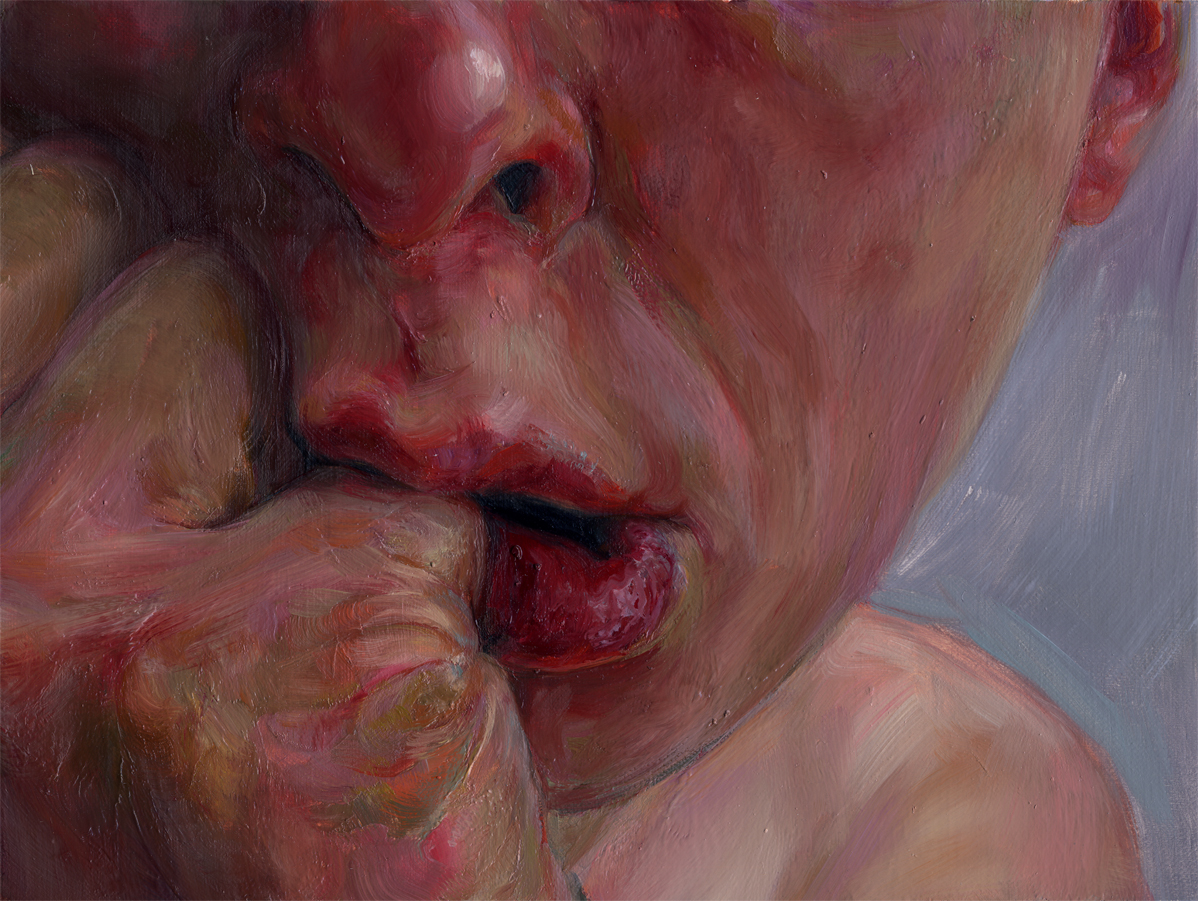
Though my process can involve a varied handling of materials and diverse imagery, what my paintings have in common is their link to representation and strong formal and conceptual underpinnings.  I paint within a realist tradition as I enjoy the disjunction of resisting or thwarting literal expectations: my paintings always give back something other than that which would be offered by the object in person or its photographic likeness.   What realism allows me to do is feign reality – to imply truths, and to lie.

Speaking of false truths in painting – there is within representation the illusion of reality; it draws on the system of beliefs that defines what we experience as reality.  I am making paintings that while presenting reality (i.e.: “truth”) still consistently draw attention to their form: within each painting there is a reminder of it’s contrivance (painting as vehicle of contrivance, painting as device, as translation) and in so doing I create friction between the image and the means by which the image is substantiated.  Of all the differing ways to insert time into a painting I find I am particularly interested in the ways I can use the process to break, or to maintain an illusion (to create a flickering or friction in the process of comprehension).  And by exploring false constraints, I have also come to recognize those I have taken upon myself as “truths”, and I attempt to dispel these beliefs which have served in the past to circumscribe my artistic practice and so to limit it.  And as I have an interest in time, I have opened my practice up to other mediums in which I can more explicitly demonstrate the temporal – such as film and sound.